Sponsor an Object
We are delighted to launch Sponsor an Object, a new fundraising campaign in support of the Museum's collections, displays and activities. The campaign gives the public the opportunity to sponsor any object currently on display for 12 months, contributing towards the costs of looking after Newton Abbot's heritage.
How to Sponsor an Object?
- Choose your sponsorship package (see below).
- Email groups@newtonabbot-tc.gov.uk, give us a call or pop into the Museum to let us know which object you're interested in.
- We will process your donation and deliver the benefits that come with your sponsorship.
- That's it! You have supported the Museum and sponsored an object for a year.
We have selected some of the Museum's most treasured items (see below) but if you have any other object in mind, maybe one that means something to you, please get in touch as nearly every item can be adopted.
Why your support matters
Museum objects need ongoing care to protect them from damage caused by age, light, handling, and the environment. Sponsoring an object helps us preserve Newton Abbot’s heritage and share it with our community through displays, learning, and future projects.
All raised funds go into the Newton Abbot Museum Support Fund and are used solely for the care, interpretation and celebration of the town’s history – helping to preserve it for generations to come.
Sponsorship Packages
Please choose your annual sponsorship package:
Object Sponsor - £50
- Acknowledgement on our website
- Acknowledgement on a label next to your object
- Collections booklet*
Collection Guardian - £100
- Acknowledgement on our website
- Acknowledgement on a label next to your object
- Collections booklet*
- Certificate of thanks
Collection Champion - £150
- Acknowledgement on our website (person or business)
- Acknowledgement on a label next to your object (person or business)
- Collections booklet*
- Certificate of thanks
- Private tour of the stores for 4 people
Heritage Patron - £250
- Acknowledgement on our website (person or business)
- Acknowledgement on a label next to your object (person or business)
- Collections booklet*
- Certificate of thanks
- Private tour of the stores for 4 people
- Private collections workshop with our Community Engagement Officer for up to 8 people
*The collections booklet showcases 46 fascinating items from the museum's collection, each presenting its own unique snapshot of everyday life. Your sponsored object may or may not feature in the booklet.
Our Current Sponsors

St Benet's Court - Collection Champion
St Benet's Court has kindly sponsored our Medieval Market Automaton.
"At St Benets Court, we are passionate about supporting our local community and preserving the rich history of Newton Abbot. Many of our residents have lived in the area for decades, and the museum provides a wonderful opportunity to spark memories, conversations and reminiscence. We are proud to support the Newton Abbot Museum and hope our sponsorship helps preserve this valuable community resource for future generations." - Michelle Dower (Registered Manager)
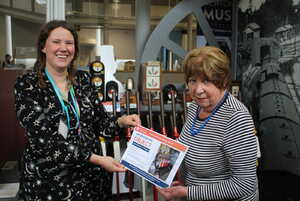
Ms Pat Cutts - Collection Guardian
Ms Pat Cutts has kindly sponsored our Railway Signals & Levers.
"My father gave 53 years of service to the railway, receiving a watch when he retired. My Grandfather was a Permanent Way Inspector in Newton Abbot from 1927 until he retired and my Great Grandfather was an engine driver. The railways are a very important part of our family history."
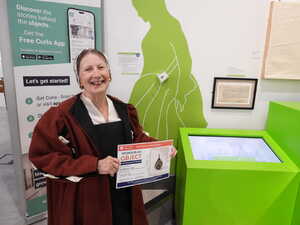
Mrs Rosemary Griggs - Collection Champion
Local author, researcher, speaker and 16th century seamstress Rosemary Griggs has kindly sponsored our Tudor Dress Hook.
"Of all the wonderful objects preserved in our museum, this one means most to me. I write about women who lived in Devon in Tudor times and study and recreate the clothes they wore. I love this beautiful dress hook because it has a story to tell, not only of a fashion wealthy women adopted to lift their skirts revealing luxurious fabric beneath, but of the woman who lost it so long ago. We don’t know for sure who she was, or where she was headed when it fell from her skirts to be rediscovered in a field in Ogwell. But one day I’ll weave her into a story. Thank you Newton Abbot Museum for keeping these important connections with local people of the past alive for us."
Selection of Objects Available to Sponsor
We have selected some of the Museum's most treasured items (see below) but if you have any other object in mind, maybe one that means something to you, please get in touch as nearly every item can be adopted.
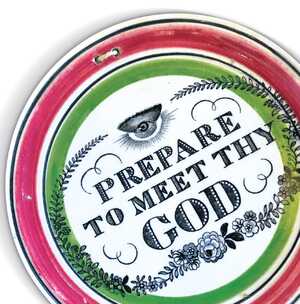
All-seeing Plate
This pink lustre-are plaque dates from the early 1800s. 'Prepare to meet thy God' is a quote from The Bible and is the most common wording seen on this type of religious plaque. It certainly would have had a big impact on the little girl whose bed it hung above! Did it make her think about hat she had done - or not done- during the day? Has she been a good girl?
Cornfoot, Colville & Co, of the North Shields Pottery (later known as Low Lights) produced transfer-printed plaques identical to this example from 1828 - 1832. The little girl who had grown up with the plate above her bed became a teacher, travelled all over the world, and lived in Highweek into her 90s.
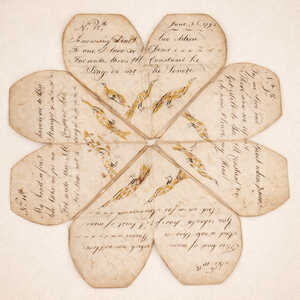
An 18th-Century Love Token
At first glance, this delicate paper token looks like a small, petal-shaped keepsake. But the single petal opens into a heart. That heart opens into another. And another.
In total, the intricate design reveals eight interlocking hearts, each folding into the next — and across the whole token are twelve verses of heartfelt poetry.

Letter from Brunel
In March 1836, William Ranger was awarded two contracts by Isambard Kingdom Brunel to build sections of the Great Western Railway line between Bristol and London.
Ranger's work was delayed by inaccurate geology reports, late amendments to the plans and atrocious weather. Brunel refused to pay Ranger as he didn't meet the deadlines imposed; then dismissed him, took his equipment and stopped his navvies working.
This letter, once attached to Ranger's list of complaints, is from Brunel saing he has added comments, including the word 'Lie' next to some of Ranger's entries!
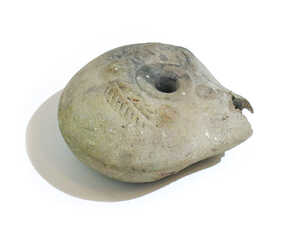
Roman Lamp
In 1979 Peter Longridge, the rector of All Saints Church, Highweek, donated this small Roman lamp to the Museum. It was found in the rectory garden (now Southlands Residential home) but how did it get there?
The Romans established Exeter in about AD 50 and left Britain in 410. History books state that the Romans went no further west than Exeter, yet evidence from Ipplepen shows a significant Romano-British site there.
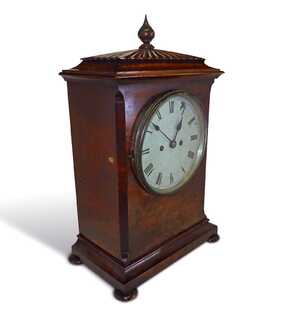
Vicary's Mantle Clock
If you had visited Mr John Vicary's office in Bradley Lane, the ticking of this mantle clock would have supplied a rythmical accompaniment to your conversation. This type of clock was traditionally placed on the shelf or mantle, above the fireplace.
The Vicary family ran wool and leather businesses in Highweek for over 200 years and were the main employers in the town before the railway works were built.
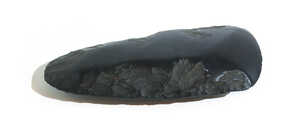
Polished Stone Axe
This axe head would have been halfted so it could be used for chopping and working wood.
When people began farming they needed to make clearings in the woods to plant their crops and have inclosures for their sheep and cattle. An axe like this would have been essential for these tasks.
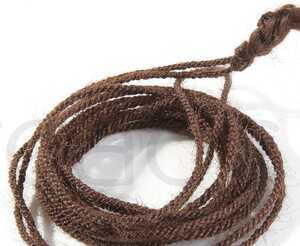
Rope Hair Swing
Maud Albrighton had very strong, long hair, She lived next to the Rope Walk in East Street where there was machinery to twist fibres into rope for the sailing ships on the River Teign. The ropemakers suggested that they could make a rope out of Maud's hair if she ever had it cut.
Eventually, Maud did have her long hair cut and the ropemakers really did make it into this 92 inch long (235 cm) skein! The hair rope was so strong, it was used to make a swing.
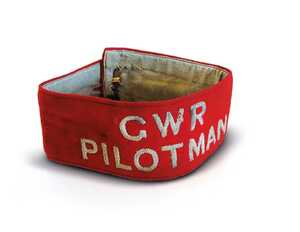
GWR Pilot Armband
A Great Western Railway Pilotman was responsible for the safety of the staff in many different situations.
He would wear this armband (which would show up well against the blue of his uniform) to make sure the factory staff and the railwayman were safe during the movement of the locomotives.
A pilotman might oversee the movement of a passenger locomotive across the tracks leading to the engine sheds, making sure all the lines were clear of wagons.
This armband dates from around the 1930/40s, when Newton Abbot Railway wagon works and passenger services were at their busiest.
 Updating page...